Natural England
Natural England
2023-2024
Provision and Management of Greenspaces and Routes that Generate Additional Use & Enjoyment
A rapid evidence review examining how the design, provision and management of green spaces and green routes affect people's use and enjoyment of urban nature, synthesising a wide range of studies into actionable guidance.
Research Services
Purpose
We were commissioned by Natural England to examine which landscape features, facilities and management approaches attract people to green spaces, increase their capacity for use, and enhance the experience. Their goal was to help more people access the benefits of nature whilst protecting biodiversity by reducing pressure on sensitive ecological sites.
Approach
Conducted a rapid evidence assessment following DEFRA methodology
Searched academic databases (ScienceDirect and Wiley Online) across three core research questions
Reviewed 92 papers covering landscape features and attractiveness, carrying capacity and use, and enjoyment and experience
Supplemented academic evidence with stakeholder calls for evidence and expert consultation
Applied rigorous quality assessment criteria based on study methodology, study group and quality of analysis
Synthesised findings into practical implications for greenspace design, management and policy
Results
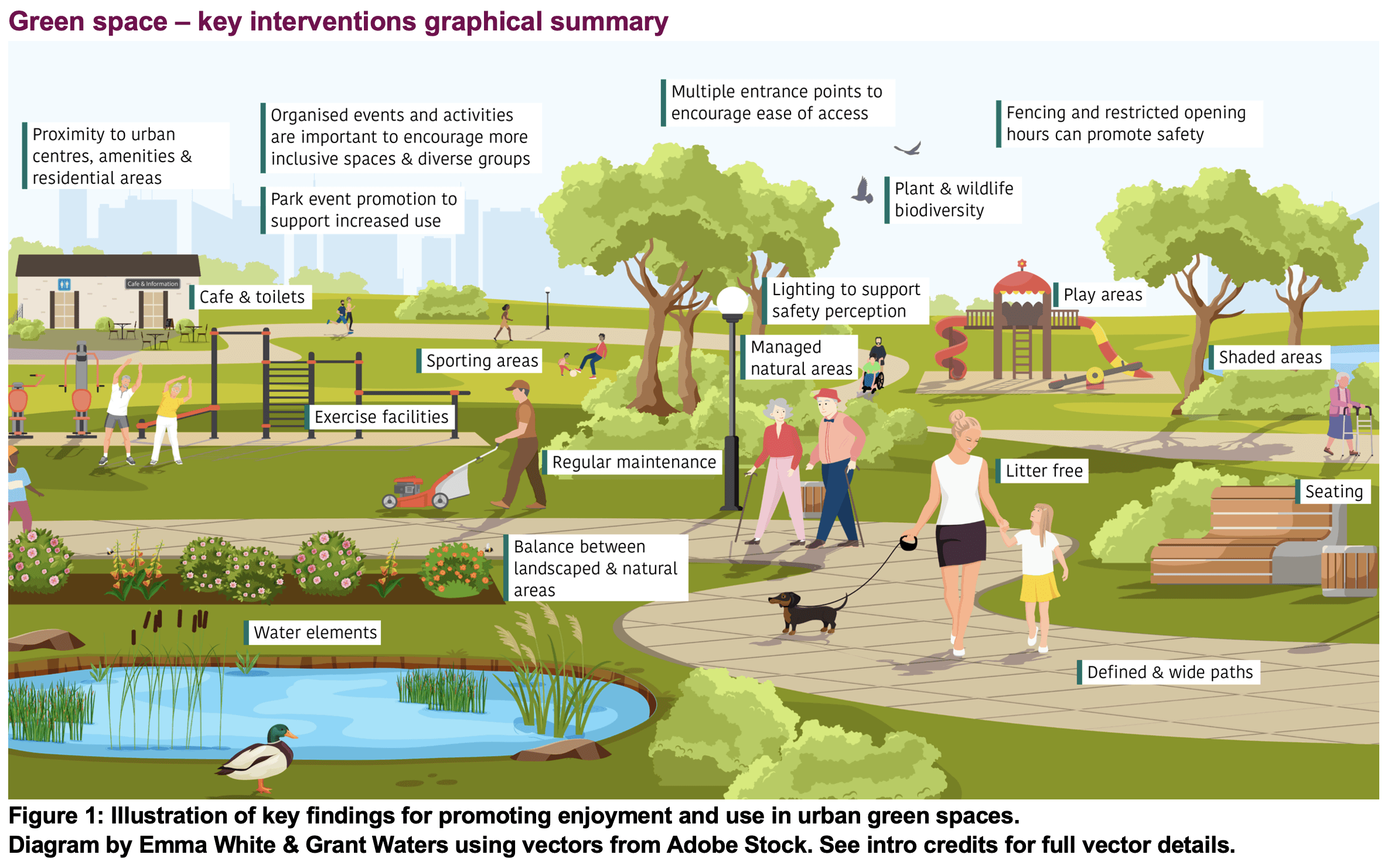
We produced an authoritative evidence base with clear, actionable findings for greenspace designers, managers and policymakers across the country. Our review of 92 studies across three key research questions revealed consistent patterns about what makes greenspaces work well.
A balance between natural and landscaped areas, open landscapes, greenery, biodiversity, water elements and good maintenance all increase attractiveness
Proximity and accessibility are the strongest drivers of greenspace use — location matters more than we might expect
Diverse route types, including waterways, cycle routes, nature trails and linear parks, increase use across broader populations
Facilities such as seating, shade, catering and toilets increase use, especially for older and mobility-impaired people
Community involvement in design and management increases use across diverse demographics
Park programming and organised events boost use particularly among women, adolescents, older people, ethnic minorities and low-income groups
Safety perceptions are critical for enjoyment, especially for women and ethnic minorities — reduced visual obstructions and considered spatial layout help create welcoming spaces
Street greening and active travel routes with trees enhance the enjoyment of everyday journeys