Defra
Department for Environment, Food & Rural Affairs (Defra)
2023-2024
Acoustic Benefits of Green Infrastructure in Urban Areas
A rapid evidence review exploring how green infrastructure can reduce noise and improve acoustic experiences in urban areas, demonstrating measurable environmental, economic, health and wellbeing benefits.
Research Services
Purpose
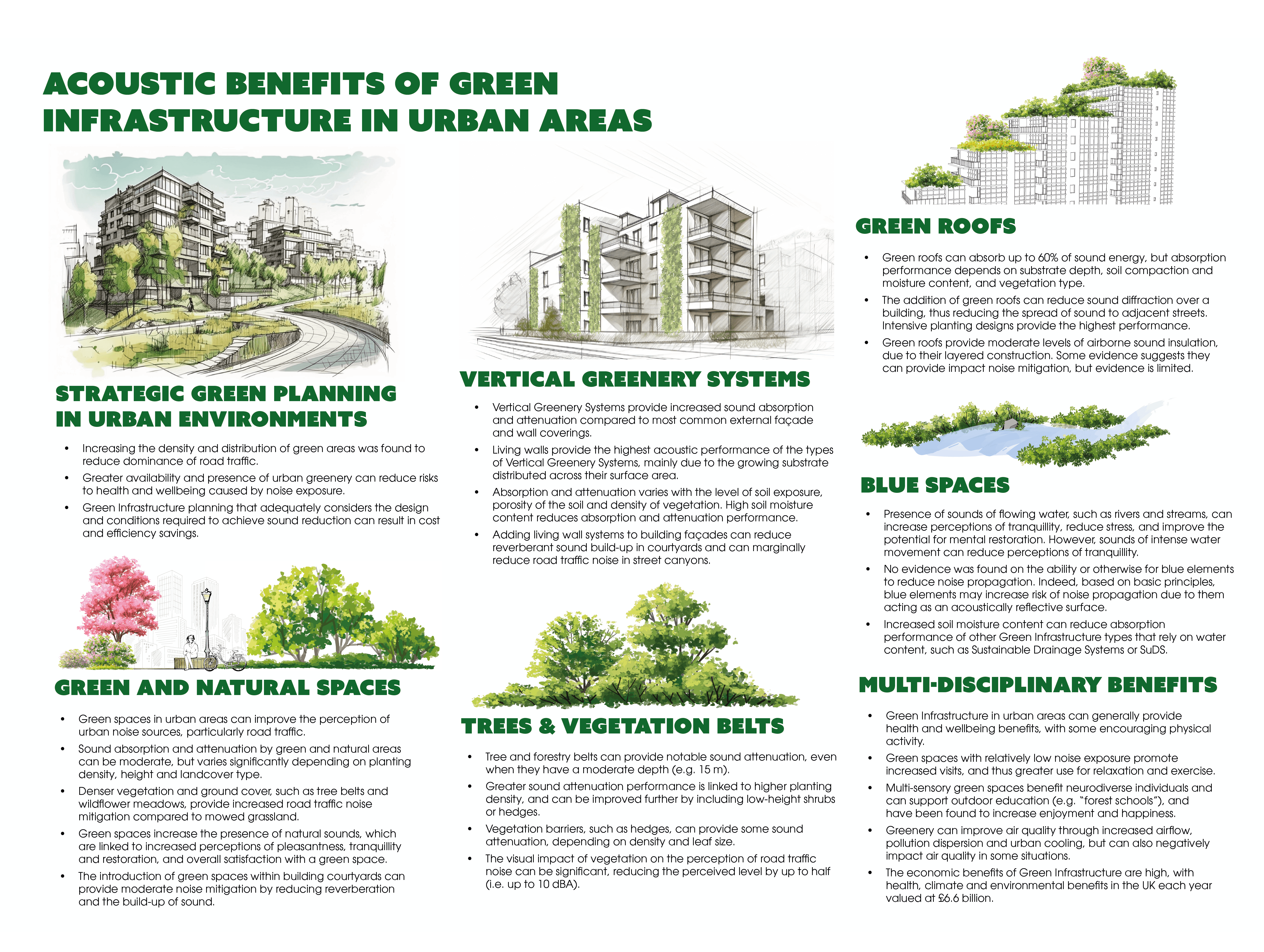
We were commissioned by Defra to examine the acoustic benefits of green infrastructure in urban environments. Our work brought together research and evidence on how trees, vegetation, green roofs, green walls, water features and landscape design can reduce noise, improve how people perceive sound, introduce positive natural sounds and support biodiversity. This evidence review demonstrates that green infrastructure delivers far-reaching environmental, economic, health and wellbeing benefits alongside noise reduction — making it a compelling case for integration into urban planning and environmental policy.
Approach
Reviewed evidence across four key mechanisms: reducing environmental noise, improving perception of noise, introducing positive sounds and enhancing the soundscape, and supporting biodiversity
Examined case studies and research findings on trees, vegetation, green roofs, green walls, water elements and landscape design
Assessed both objective sound reduction evidence and subjective perceptual and health outcomes
Reviewed policy context, including the 25 Year Environment Plan, National Planning Policy Framework, Natural England's Green Infrastructure Framework and Environmental Noise Regulations
Identified evidence gaps and made recommendations for acousticians and urban planners
Results
Our review produced a comprehensive evidence base confirming that green infrastructure delivers meaningful acoustic benefits for urban environments. Key findings include:
A 15-metre forest belt can achieve approximately 6 dB of noise reduction
Green roofs provide airborne sound reduction of 29-37 dB, rising to 43 dB with an insulated cavity
Views of green infrastructure can reduce perceived road traffic noise by up to 10 dB
Neighbourhoods with more than 5% tree coverage showed reduced wellbeing risks from noise
Adding vegetation to solid noise barriers can enhance performance by 4 dB
Living walls in courtyards achieved an 81% reduction in reverberation time and a 9 dB speech build-up reduction
A case study demonstrated £6 million in noise reduction benefits from just a 3.9% increase in forestry cover
Current noise policies do not specifically mention green infrastructure — a critical gap we identified for policy advancement
Quotes
“Thank you and your team for your brilliant, professional work and collaboration on this project. It has been a pleasure to co-design the work with you and see it positively pan out in the way that it did.”
Luca Marazzi, Defra