OrganiCity Phase 1
OrganiCity
2016-2017
Discovering Tranquillity in the City
We explored whether tranquillity can be found in cities and what it means to urban dwellers, proving that tranquil spaces correlate with areas of low pollution and deliver measurable health benefits for city residents.
Research Services
Purpose
Tranquil City began as a grassroots urban initiative to understand the role of tranquillity in city living. Through crowdsourced data collection and environmental analysis, we set out to prove that tranquil spaces correlate with areas of low pollution, and that choosing tranquil routes can deliver measurable health benefits for city dwellers. Our research combined community insights with rigorous environmental data to demonstrate that cities can be designed with wellbeing in mind.
Approach
Crowdsourced data via Instagram (#tranquilcitylondon) to identify what tranquillity means to Londoners, gathering 986 posts
Analysed photos and videos to create a visual matrix of tranquil space characteristics — stillness, nature contact, perspective, envelopment, curiosity
Collated open data from DEFRA, Department for Transport and the London Atmospheric Emissions Inventory to map noise and air pollution
Used GIS mapping to analyse the relationship between crowdsourced tranquil spaces and pollution exposure
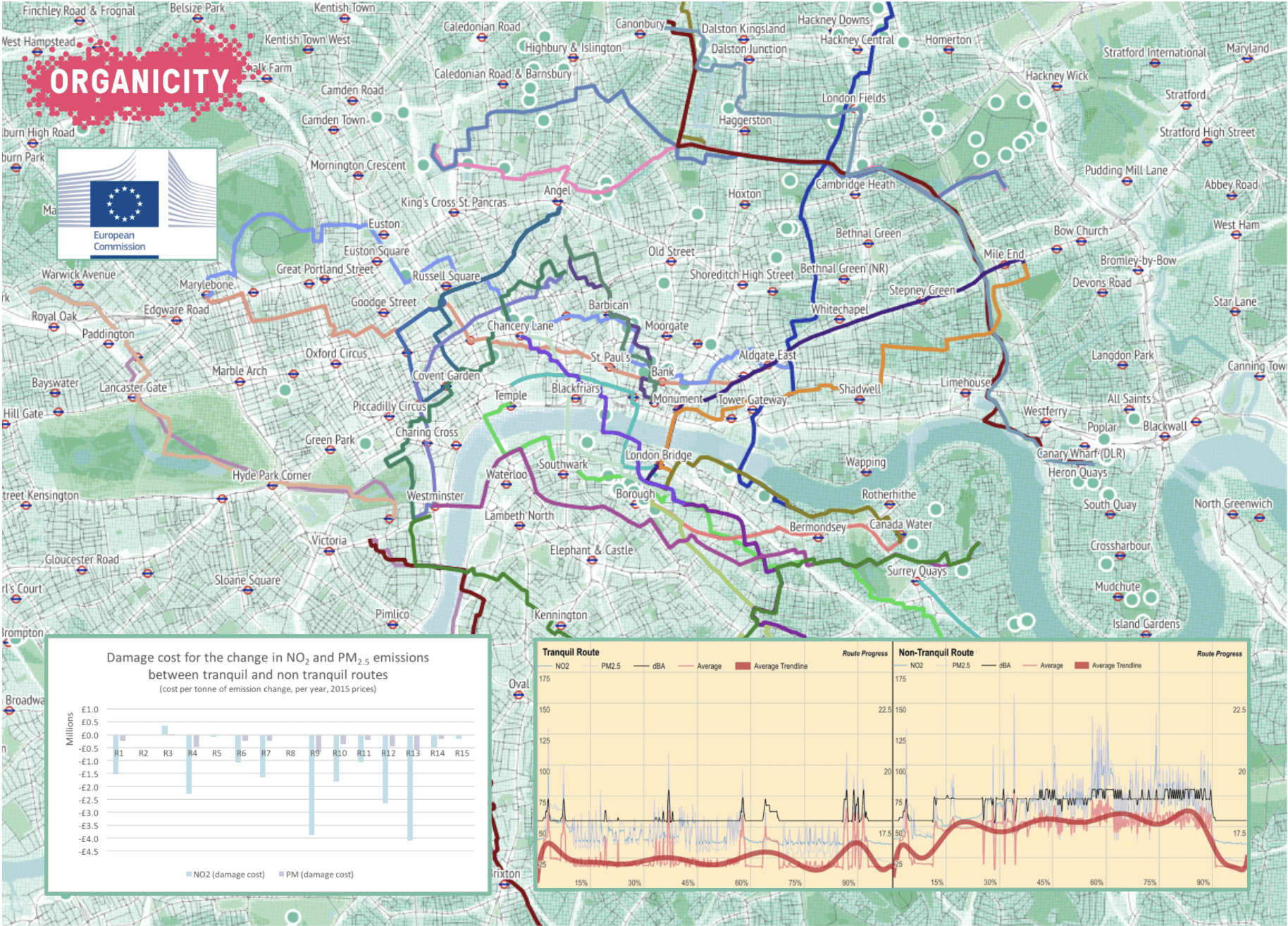
Held a public workshop with 40+ participants at the Urban Innovation Centre, Farringdon, where 5 teams drew walking routes and explored tranquil alternatives
Conducted a health benefit monetisation analysis using Disability Adjusted Life Years methodology
Results
Our research demonstrated a clear link between tranquil spaces and lower pollution, with significant health benefits for those who choose greener routes. The findings provide compelling evidence that designing for tranquillity is not just about wellbeing—it's a measurable economic and environmental benefit for cities.
986 Instagram posts mapped across London identifying tranquil spaces
Tranquil areas averaged 40 µg/m³ NO2 vs 67 µg/m³ in non-tranquil areas
Noise levels averaged 56 dBA in tranquil spaces vs 64 dBA in non-tranquil
92% of tranquil spaces included greenery, 32% included water, 54% included positive soundscapes
Workshop routes showed an average 49% improvement across environmental metrics
Average 33% reduction in noise-related health costs — equivalent to £130 savings per person per year
Combined air quality benefit of £1.6 million per year across all tranquil routes
Choosing tranquil routes daily could result in an additional day of healthy life per year